
Registration
 play_arrow

 play_arrow
Despite a year marked by political uncertainty and policy swings across the US, the infrastructure finance market continues to demonstrate exceptional resilience. Capital raising has taken a turn for the better, mega funds are scaling to record levels and investor demand for digital and energy transition assets is accelerating. Structural drivers such as AI-driven power demand, supply chain reshoring, transportation renewal, and grid modernization, are underpinning sustained momentum across the sector.
Panelists will discuss:
- How is the infrastructure finance market powering ahead, even as political, and regulatory turbulence intensifies?
- Which unstoppable structural forces are driving long term investment momentum across the US and globally?
- Where are the most compelling opportunities emerging across digital infrastructure, energy transport, and essential services?
- How are investors striking the right balance between discipline, risk, and deployment in today’s rapidly shifting landscape?





 play_arrow
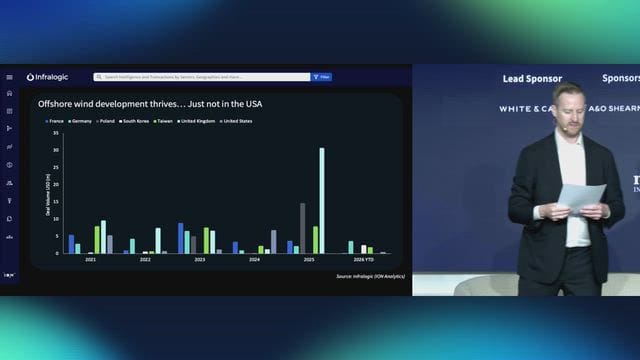
US energy policy has shifted away from subsidizing clean energy developments in favor of hydrocarbons, ending the freeze on LNG export permits and placing offshore wind developments on hold. These policy changes created renewed momentum in the LNG market, even as new tariffs and major legislative reforms introduced additional regulatory uncertainty across the sector. Despite these headwinds, the renewables industry has shown notable resilience. Activity remained strong, driven by a rush to safe harbor early-stage projects ahead of updated tax credit deadlines and by rapidly rising electricity demand, particularly from AI-driven data center growth. While offshore wind development slowed significantly due to federal restrictions, onshore solar and storage assets continued to attract meaningful investment. Long-term development pipelines may face increasing pressure, but with near-term demand for power expected to continue, could this outweigh the impact of reduced federal incentives?
- How are shifting US tariffs and reduced clean energy tax credits reshaping investment strategies across the energy sector?
- Where is the strongest risk adjusted returns likely to emerge across LNG, renewables, and storage over the next 2–3 years?
- Why do onshore solar and storage continue to attract capital despite policy headwinds, and how is investment being reallocated across the energy mix?
- Which new energy technologies are mature enough to attract infrastructure fund capital and project finance?
- How are energy investors accounting for uncertainty and skepticism regarding AI growth and the resulting demand for data centers and power?






Morning refreshments and networking break
 play_arrow
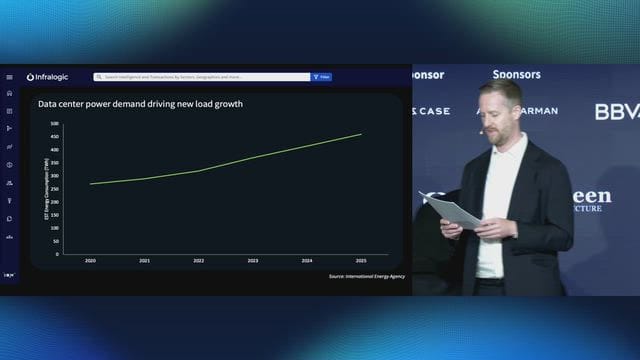
Artificial intelligence is reshaping the global infrastructure industry at unprecedented speed. In 2025, the US digital infrastructure market experienced a step‑change as AI‑driven demand pushed data centre deployment, deal sizes, and capex requirements to new heights. What was once a niche asset class has evolved into a strategic cornerstone of the modern economy, blurring the lines between technology, real estate, and traditional infrastructure.
- How is AI transforming digital infrastructure as an asset class?
- How is the rise of AI changing financing structures and investor behavior?
- Is investor exposure to AI infrastructure becoming too concentrated?
- How are infrastructure investors using AI within their own organizations?
- Could the AI boom cool and what happens if it does?




 play_arrow
As data center development accelerates, access to power and suitable land has become a defining constraint shaping the industry. Grid queues, limited substation capacity, and scarce powered land are forcing developers to rethink traditional site‑selection models. To keep build‑outs on schedule, many are turning to behind‑the‑meter generation, land banking, private‑wire connections, and hyperscale campus strategies designed to secure long‑term, scalable load. These constraints are reshaping both where facilities can be built and what it takes to get them permitted, interconnected, and viable at hyperscale. At the same time, investors and lenders are rapidly adapting. Deals increasingly integrate land control, on‑site or near‑site generation, and future power expansion rights into a single financing package. New partnerships between data center developers, utilities, energy producers, and infrastructure funds are emerging to accelerate timelines and navigate interconnection delays.
- How are developers sourcing powered land, assembling multi‑parcel sites, and prioritizing locations with scalable future interconnection rights?
- How are financing packages combining data center facilities with land control, behind‑the‑meter generation, and transmission upgrades to make projects bankable?
- How is gas‑fired, hybrid, and other onsite generation solutions being used to overcome grid delays, and what operational, cost, and ESG trade‑offs do developers need to balance when deploying them?
- How are developers, utilities, hyperscalers, and energy producers collaborating to shorten timelines, share risk, and unlock sites previously considered unviable?





Lunch
 play_arrow
Transportation assets continue to attract significant investment as global markets experience volatility and geopolitical uncertainty. Ports, highways, rail, and essential freight corridors remain indispensable to national and global mobility, and investors are increasingly doubling down on these long‑life, cash‑generative assets. The resilience of the sector was underscored in 2025 by the SR 400 Express Lanes Project, the largest US transportation greenfield/P3 transaction of the year, which highlighted renewed appetite for well‑structured projects that relieve congestion and improve critical mobility.
- Why are core transportation assets still drawing strong investment as essential, long‑life, inflation‑linked infrastructure?
- How is global uncertainty, shifting trade patterns, and geopolitical instability reinforcing the importance of durable transportation infrastructure that underpins economic continuity?
- What does the SR 400 Express Lanes Project signal about renewed appetite for well-structured greenfield opportunities, and how do P3 models enable delivery of major capacity upgrades?
- How do automation, traffic management technologies, predictive maintenance, and smarter operations improve the performance and resilience of transportation assets and influencing investor priorities?





 play_arrow
With bank liquidity tightening and capital needs for AI ready data centers and energy projects soaring, investors are tapping alternative sources of capital. Private infrastructure credit models enable flexible, tailored structures at the scale next gen infrastructure demands, private credit has become a critical financing engine, and developers are keen to tap the securitization market for derisked assets. This panel will explore where capital flows to and from, how deals are getting structured and financed, and what risks and returns look like across the thriving digital and energy sectors.
Is private credit uniquely positioned to finance next generation digital and energy infrastructure and will bank liquidity tighten?
- How are private infrastructure credit structures being tailored to address the massive capex, construction risk, and power availability challenges of AI ready data centers and 21st century-scale energy projects?
- What are the biggest underwriting and risk assessment challenges today and how are different lenders pricing and structuring around them?
- Over the next 12–24 months, where do you see the strongest opportunities and the biggest red flags for private credit deployment across digital and energy?






Afternoon refreshments and networking break
 play_arrow
As mega‑funds raised by giants such as Brookfield, Macquarie, and BlackRock continue to grow in scale, the competitive landscape for infrastructure capital is shifting dramatically. LP consolidation into fewer, larger vehicles has intensified pressure on mid‑market managers, but at the same time, the explosion of new capital channels and specialized investment strategies is creating new avenues for differentiation. The question is no longer simply whether mid‑market firms can compete with the mega funds, but where can they carve out durable advantage in an increasingly segmented and strategy‑driven market.
- How are mega‑funds reshaping competition for capital and deal flow and where can mid‑market managers still differentiate and win?
- How are new capital‑raising channels, private wealth platforms, insurance capital, and customized SMAs, changing the fundraising landscape for mid‑market GPs?
- What opportunities are emerging from the rise of specialized strategies such as energy transition funds, AI/digital infrastructure funds, and sector‑focused vehicles and how can mid‑market firms use specialization to compete with scale?
- How are LP expectations evolving in an era of strategy proliferation, and what must mid‑market managers demonstrate to continue attracting commitments alongside the mega‑funds?






Closing remarks
Cocktail Reception
Confirm cancellation
An error occurred trying to play the stream. Please reload the page and try again.
CloseSign-up to join the ION Analytics Community to:
- Register for events
- Access market insights
- Download reports